
Jesus Wouldn’t Support Church NDAs… Here are 3 Reasons Why.
Trust in pastors has hit an all-time low in America. That’s according to recent Gallup research, [1] which shows that trust in clergy has plummeted from 64% in 2001 to a paltry 27% in 2025. And the decline has been steady, falling 37% over the past quarter-century. The last decade or so has been even more stark. Lifeway Research states, “The last time most Americans believed clergy had high or very high honesty and ethical standards was in 2012. The rating of pastors has declined every year except one since then.” [2]
This tumultuous fall begs an important question. If Jesus introduced himself as the Way, the Truth, and the Life, then how is it the very leaders who claim to represent him are seen as untrustworthy?
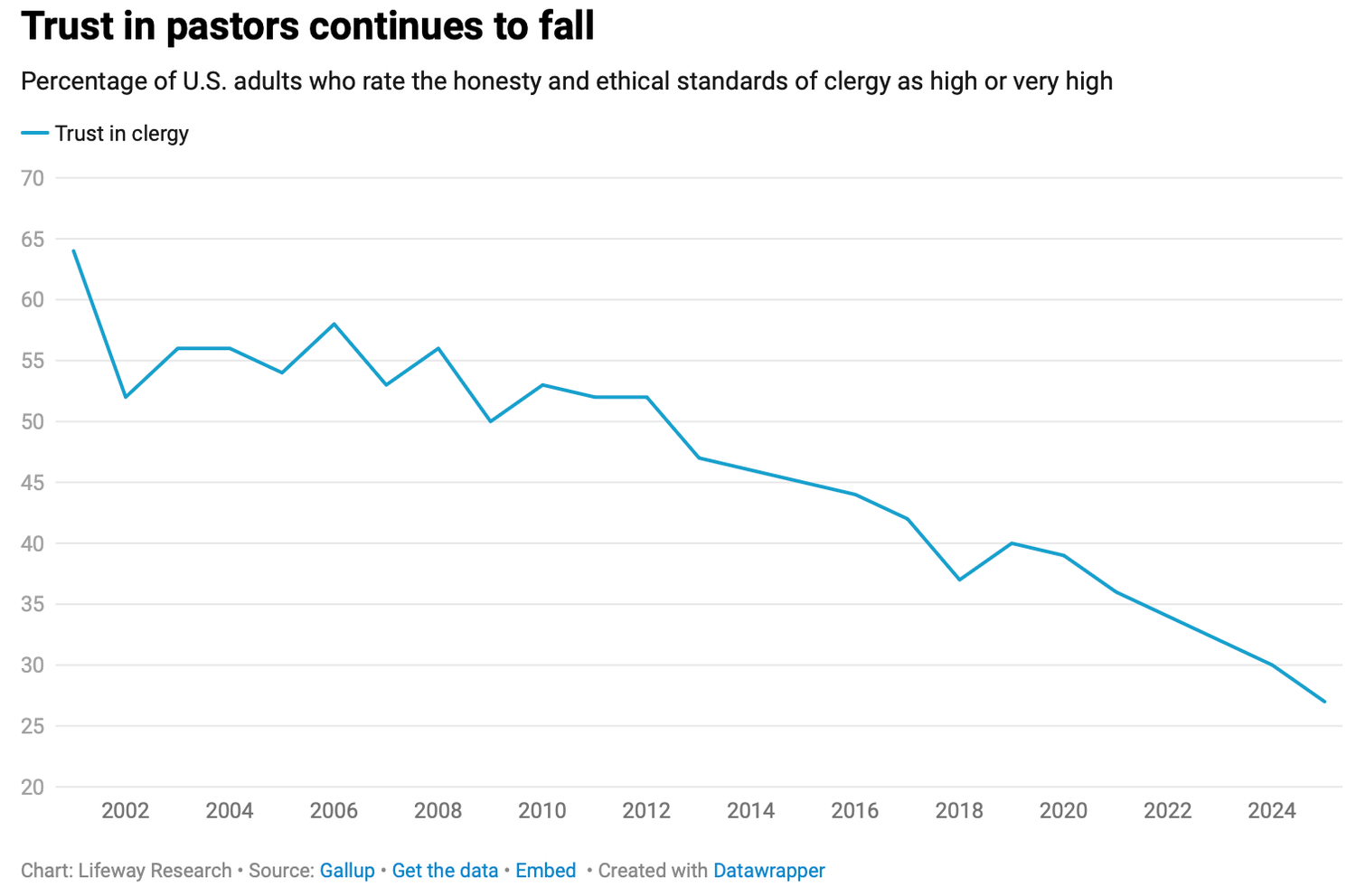
My theory is simple: Church leaders lose trust when they embrace practices that are antithetical to Jesus. One such practice is the broad-scale use of NDAs in churches today.
Jesus wouldn’t co-sign churches using NDAs. He wouldn’t have signed one, and he would not support their use. Any Christian with an honest reading of the bible should know that.
Heck, any person, Christian or not, who reads the words of Jesus should see how incompatible the practice of NDAs is with the Messiah!
Pastors and church leaders give a lot of excuses for why churches use NDAs, but none of them hold water when we look to Jesus and the pages of scripture. So, as heartbreaking as it is for me, as an ordained pastor, to see the loss of trust in the clergy, it’s also not surprising. If Christians want to see trust in the Church and its leaders restored, we will have to advocate for the cessation of deceptive-looking practices like NDAs in its stained-glass walls.
But what about Jesus? Where would He have stood on NDAs, Jeff? And how do you know? Well, I’m so glad you asked. Let’s look together at three reasons why Jesus would be against NDAs in His Church.
Reason #1: Jesus Disparaged Religious Leaders Often
One of the most harmful parts of a church NDA (and one of the most common) is a non-disparagement clause. This little clause, usually only one sentence long, can hold the signer hostage and in fear for the rest of their life.
So, what is a non-disparagement clause, and why does it matter?
A non-disparagement clause is a legal promise not to say anything negative or critical that might harm a person’s or organization’s reputation. Sharing something true, sharing an opinion, or telling someone else about an immoral or sinful act you witnessed could all constitute disparagement.
But if you signed anything with a non-disparagement provision in it, any of those things could get you sued.
Non-disparagement clauses are in almost every church severance agreement we see at SAI. The problem is non-disparagement isn’t concerned with the truth, but the reputation of a church and/or its leaders. It’s hard to protect the truth and reputation at the same time. When one takes precedent, the other usually takes a back seat.
Yet, non-disparagement has become industry standard for church NDAs. Jesus wouldn’t have signed anything with the clause in it. If asked to, He may have flipped more tables.
Jesus routinely disparaged the religious leaders of His day, and he usually did so publicly. It’s a big part of why they hated him.
Matthew 23 is almost entirely Jesus disparaging the scribes and Pharisees. He called them things like snakes, white-washed tombs, and hypocrites. Jesus called Herod Antipas “that fox” and the temple authorities as a “den of robbers.” He even called Peter, his own disciple, “Satan.” Jesus would rebuke and disparage friend or foe when their harmful actions called for it.
When Jesus saw religious leaders prey on or manipulate the vulnerable, He called them out. He attacked their reputations publicly, exposed systemic hypocrisy, and demanded moral alignment between their teaching and actions.
Jesus disparaged abusive religious authority figures because He refused to let legalistic reverence shield bad actors from public scrutiny and accountability, the exact protections that modern non-disparagement provides.
Jesus wouldn’t have signed a non-disparagement agreement, although I’m sure the Pharisees would have loved for Him to. Instead, He would have been much more likely to publicly rebuke them over even the attempt.
When church leaders ask people to sign agreements with clauses like this, they ask Christians to refrain from something Jesus did often. How dare we respond like Jesus when we see leaders sin or abuse their authority?!
Imagine if Jesus had signed a non-disparagement clause. He wouldn’t have preached the sermon on the mount, confronted the blind guides, or cleansed the temple. I’m glad non-disparagement wasn’t industry standard in first-century Judaism.
Reason #2: What Jesus Said About Truth
Jesus didn’t just teach truth as a concept; He claimed to be the Truth(John 14:6.)
He told His followers the truth would set them free. In John 3:20, Jesus taught that “Everyone who does evil hates the light, and will not come into the light for fear that their deeds will be exposed.” The Apostle John echoed this in 1 John 1:5-7. “God is light, and in Him there is no darkness at all. If we claim to have fellowship with Him and yet walk in the darkness, we lie and do not live out the truth. But if we walk in the light, as He is in the light, we have fellowship with one another, and the blood of Jesus, His Son, purifies us from all sin.”
Jesus was truth and the light of the world. He knew that truth happens in the light, and that the darkness usually hides something. An NDA, no matter what kind it is, relegates truth to darkness. Confidentiality and non-disparagement provisions keep people from telling the truth and often require them to lie just to protect reputations and PR narratives. They, by definition, hide truth in darkness so that it cannot be exposed.
Remember what the Bible says, though. “God is light, and in Him there is no darkness at all (emphasis added).” If there is no darkness in Jesus, then He cannot have anything to do with an NDA that demands it.
No church or leader concerned with truth needs an NDA. Jesus wouldn’t have signed one or asked anyone else to do so. So why would His Church act any differently?
“If there is no darkness in Jesus, then He can’t have
anything to do with an NDA that demands it.”
Reason #3: Jesus Commanded Public Exposure
for Unrepentant Sin
In Matthew 18:15-20, Jesus tells us how to deal with sin in the church. You start out by confronting the person who sinned against you one-on-one and hope that fixes it. Step two brings a few witnesses into the picture. But the final step demands a public rebuke that tells the issue to the whole church.
For those who refuse to listen, they are disciplined publicly before a church that subsequently treats them as if they were a pagan or tax collector. It’s brutally honest, wildly public, and deeply painful. Because sometimes that’s what it takes to deal with sin. Sometimes, that’s what it takes to lead someone to repent.
Think about what Jesus didn’t say. He didn’t instruct a leader to get the offended person to sign an NDA. He didn’t tell His followers to let it go just to protect the unity of the church. Instead, He told his followers to deal with the sin head-on and, if necessary, publicly.
Nothing was to be hidden. And it would have been disparaging to the offender and painful for everyone. But it was also necessary according to Jesus.
A silencing NDA would have made Christ’s teaching impossible to obey. Modern church NDA’s do the same thing. They implicitly and explicitly forbid the final step of biblical church discipline from Matthew 18. They make Christians stick their fingers in their ears and act like 1 Timothy 5:19-20 aren’t in the Bible. They replace community accountability with contractual concealment.
In the name of Jesus and unity, church NDAs can legally suppress obedience to Christ by threatening the penalty of a long and expensive lawsuit.
“Church NDAs replace community
accountability with contractual concealment.”
But What About the Messianic Secret?
Anytime I discuss something like this, someone will inevitably enter the chat with the rebuttal, "But what about the secret Jesus kept and asked his disciples to keep?" In what feels like a theological gotcha moment, these critics believe they have Biblical proof of Christ's pro-secret and pro-silencing position. However, upon closer look, I don't believe that's the case.
The messianic secret is the common name given to Christ's instructions to His disciples not to tell people He was the Messiah or about certain miracles he performed. Examples can be found in passages like Mark 8:29-30, Matthew 16:16-20, Luke 9:20-21, and Mark 1:43-45.
While this happens in all four gospels, Jesus does this only eleven or so times. So, it wasn't very common. Moreover, Jesus' command of secrecy was both temporary and time-bound. When He instructed followers not to tell of His identity or of the miracles they saw, it was a temporary instruction until the time was right. Essentially, He wanted them to wait for the cross and the resurrection.
The reason for this was for all things to be fulfilled in the right time. This means the secret was never to be kept long-term, but always for three years or less. It was also for prophetic and pedagogical timing, never to hide sin or allegations of misconduct.
Overwhelmingly, modern church NDAs are perpetual and ongoing contracts with no time limits, more akin to lifelong gag orders than a temporary secret. Worse, they are most often written in language that keeps people from telling the truth and too often requires them to lie in some situations. Jesus never gave a gag order and never required His followers to sin in order to keep the secret.
In reality, people didn't always listen. Jesus would tell some to "tell no one" only for them to immediately start shouting it publicly in the next city. Yet, He never threatened them, rebuked them, or punished them for it. Instead, Jesus saved His harsh words and rebukes for the religious leaders who were using and manipulating people for their own gain.
So, yes, Jesus does show us that not all secret requests are bad. At the same time, He models some important things for us. 1) Secret keeping should have a time limit. 2) Secret keeping should be for revealing something properly, not to hide wrongdoing. 3) Threats of punishment have no place in requesting a confidence, even when someone breaks that secret.
If we follow the model of Jesus, we get something very different than the usual church NDA.
I’ve heard pastors fight to explain why NDAs are good and necessary for a church that wants to honor Jesus. But for the life of me, I can’t see how they justify it with Scripture. I don’t understand how a legal contract that stops people from doing what Jesus did, telling the truth Jesus promised would set us free, and following His command for dealing with sin in the church could ever be good or necessary.
Over the past two decades, scandal has become an all-too-common fixture in the house of God. We’ve seen child abuse, adult clergy sexual abuse, disqualifying sin, moral failures, financial impropriety, fraud, domineering leadership, and the like. But what if the biggest scandal of all was the cover-up?
What if the NDAs and hush-money payments cost the church more in trust than the original sins? I believe heinous sin is made worse when people know about it and try to cover it up. I hear from people all the time, both inside and outside the Church, who talk about the devastating impact of when they first found out about church NDAs and monetary payments for people’s silence.
They know all people are capable of great harm when they allow sin a place at their table. They hate the abuses. They grieve them. Yet they understand that some bad actors will trick us all.
But when they find out that the original sins were silenced or allowed to grow because of legal agreements, legal threats (which an NDA inherently is), and under-the-table hush money from tithes, that’s what breaks their hearts and shocks their systems. It’s the cover-up, or even just the perception of one, that breaks people. It changes the way they see the Church. It shatters trust in an instant that took a lifetime to build.
With trust in church leaders at a historic low, can the Church afford to use NDAs any longer? I don’t think so. But one thing I know for sure: Jesus wants nothing to do with them.
Subscribe
Get more content like this and updates from SAI by subscribing below.
Your email address is safe with us .We never share your information with anyone

Standing against spiritual abuse through awareness, research, & resources.
Accountability
2024 © SPIRITUAL ABUSE INSTITUTE